First Insight Bloghttps://www.firstinsight.com/blog Introducing the First Insight Blog! Find all our posts from great authors. Learn about big names in wholesale to women's clothing culture and everything in between, right here on our Blog.en-usWed, 17 Dec 2025 21:20:16 GMT2025-12-17T21:20:16Zen-usThe Digital Twin Delusion: Why Replacing Real Consumers With AI Replicas Creates Trust Collapse, P&L Risk, & Viral Backlashhttps://www.firstinsight.com/blog/the-digital-twin-delusion

Retailers today are moving faster than ever to adopt AI. Automation, prediction, personalization - every team is under pressure to use AI to make smarter decisions at scale. But in the rush to move quickly, many brands are quietly making a risky tradeoff: replacing real consumer feedback with AI-generated replicas known as digital twins or synthetic personas.
Retailers today are moving faster than ever to adopt AI. Automation, prediction, personalization - every team is under pressure to use AI to make smarter decisions at scale. But in the rush to move quickly, many brands are quietly making a risky tradeoff: replacing real consumer feedback with AI-generated replicas known as digital twins or synthetic personas.
The pitch is seductive: no surveys, no panels, no friction. Instant feedback, infinite scale.
But there’s a fundamental problem.
Consumers hate it.
And once they understand what’s happening, trust collapses—and a chain reaction begins that impacts purchasing behavior, loyalty, and brand reputation.
First Insight surveyed 1,303 U.S. consumers to understand how shoppers truly feel about digital twins. The results are unambiguous, and for retailers relying on synthetic personas to guide their decisions, deeply alarming.
Let’s break it down.
Consumers Don't Understand Digital Twins - But Once They Do, Trust Collapses
The most dangerous part of this trend is the gap between what consumers think brands are doing and what brands are actually doing.
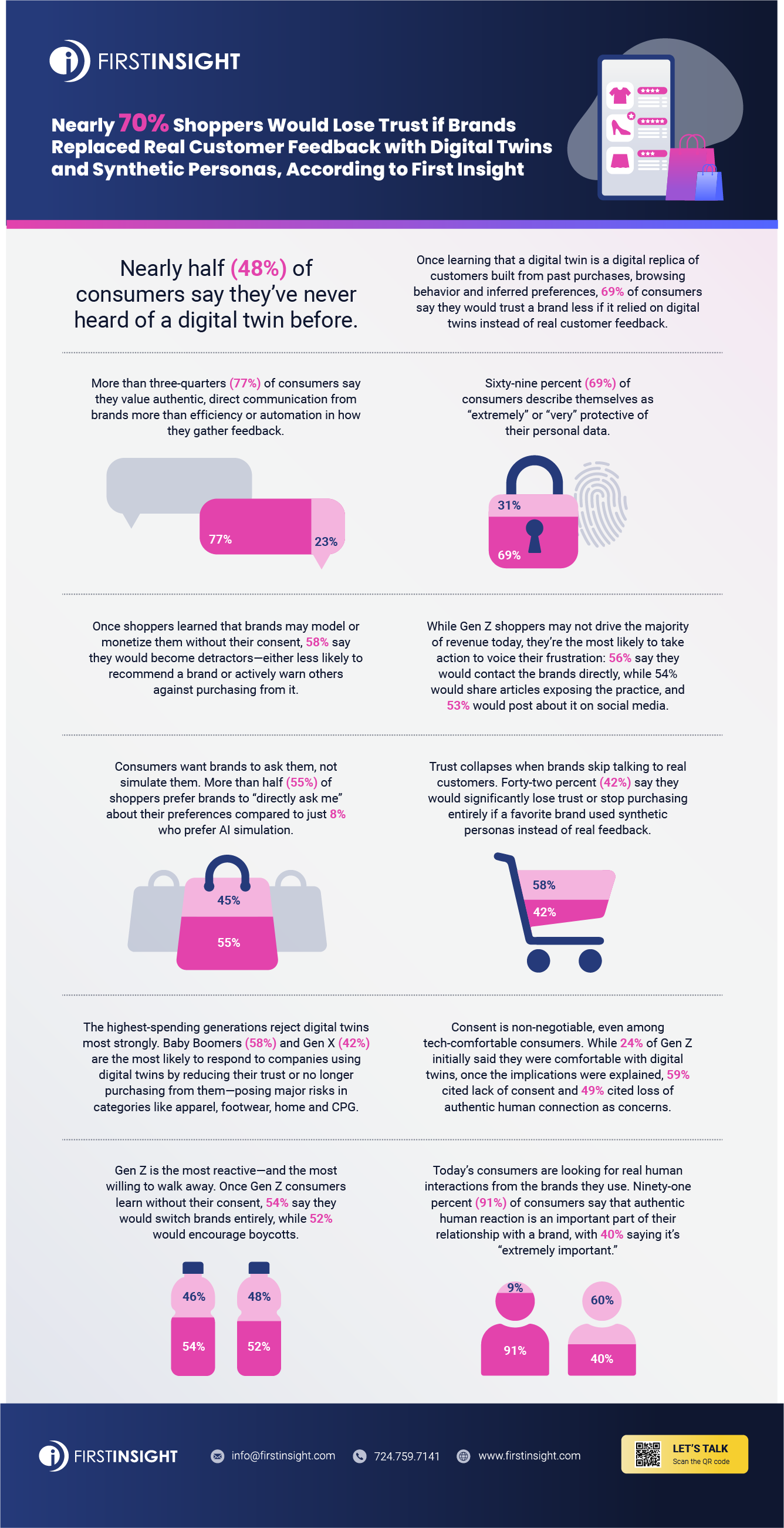
Nearly half (48%) of consumers have never heard of digital twins.
Silence is often misinterpreted as approval. But silence is not consent.
Once consumers learn that digital twins are digital replicas built from past purchases, browsing data, and inferred preferences—used to simulate their behavior without asking them anything—opinions shift immediately and dramatically:
- 69% would trust a brand less
- 42% would significantly lose trust or stop purchasing
- 58% would become detractors
This isn’t a soft decline in sentiment. It’s a collapse.
And it doesn’t stop at trust. It triggers a kinetic cascade of consumer reactions—reduced purchasing, brand switching, and even viral amplification.
The P&L Risk: The Highest Spending Generations Reject Digital Twins Hardest
Brands often assume younger consumers are the most sensitive to data privacy, but our findings show otherwise.
Baby Boomers (58%) and Gen X (42%)—the groups that drive the highest proportion of discretionary retail spending—are the most likely to reduce purchasing or stop buying altogether when learning a brand uses digital twins.
This creates direct financial exposure, particularly in categories where Boomers and Gen X dominate:
- Apparel
- Footwear
- Home
- Specialty
- CPG
Digital twins aren’t a shortcut to efficiency. They’re a shortcut to lost margin.
The Viral Risk: Gen Z Turns Digital Twin Usage Into a Public Crisis
While Boomers and Gen X represent the financial risk, Gen Z represents the reputational one.
When Gen Z discovers a brand is simulating them without consent, they take action - publicly, loudly, and quickly.
Here’s what Gen Z says they would do:
- 53% would post about it on social media
- 54% would share articles exposing the practice
- 52% would encourage boycotts
- 54% would switch brands
- 56% would contact the brand to complain
This is not theoretical. This is a documented chain reaction:
Awareness → Outrage → Sharing → Boycott → Abandonment → Direct confrontation
If even a fraction of Gen Z engages, brands lose control of the narrative within hours. One TikTok is all it takes.
The Accuracy Myth: Digital Twins Would Have Predicted the Wrong Outcome
Many retailers assume digital twins deliver better or faster predictions. But the data shows the opposite.
A synthetic model would look at Gen Z’s behavior - high tech adoption, comfort with apps, automation, and personalization - and conclude they would be comfortable with being modeled.
Some models would likely predict:
- “Gen Z is tech-comfortable”
- “Gen Z values efficiency”
- “Gen Z will accept digital twins”
But the real data tells a different story:
- 59% cite lack of consent as a concern
- 49% cite loss of authentic human connection
- 53% say they would post publicly
A digital twin would have predicted the opposite of what consumers actually feel.
That’s not predictive analytics.
That’s a blind spot.
Digital twins smooth over nuance, reinforce historical patterns, and ignore emerging sentiment - precisely the factors that determine future behavior.
What Consumers Actually Want: Ask Me, Don't Simulate Me
Our study revealed a sentiment that is both simple and profound:
Consumers don’t hate AI. They hate being simulated.
Here’s what they actually want:
- 55% want brands to directly ask them about preferences
- Only 8% prefer AI simulation
- 77% prefer authentic feedback collection over efficiency or automation
- 91% say authentic human reaction is important to their relationship with a brand
Consumers want agency. They want consent.
They want to be involved in decisions about them - not replaced by a mathematical approximation of themselves. Brands cannot claim to be consumer-centric while removing the consumer from the process.
The Path Forward for Retailers: AI Should Amplify Human Insight, Not Replace It
The answer isn’t to avoid AI. It’s to use AI differently - and responsibly.
The winning model is:
Real consumers → Real feedback → AI-powered analysis → Confident action
Retailers should:
- Engage real customers in real time
Ask shoppers directly what they think about new products, pricing, packaging, and experiences.
- Reward participation through loyalty and value exchange
Consumers are willing to share preferences when they feel valued, not processed.
- Use AI as an amplifier - not a substitute - for human experience
AI should help synthesize, categorize, predict, and scale insight…
Not replace the human voice.
The Bottom Line
Digital twins and synthetic personas aren’t just inaccurate - they’re dangerous.
They create:
- P&L risk (Boomers + Gen X reduce or stop buying)
- Reputational risk (Gen Z takes it public)
- Strategic risk (synthetic models predict the wrong outcomes)
- Trust risk (consumers respond with distrust, backlash, and switching)
Retailers win when they engage real consumers, honor authenticity, and build AI that strengthens - rather than replaces - the human connection.
Because you can’t build trust on a simulation. And you can’t predict customer behavior by removing the customer from the equation.
Ready to turn real customer insight into confident retail decisions? Book a call with the First Insight team and see how AI + authentic consumer data can protect trust, margins, and your P&L. 🐙✨
Book a complimentary 30-minute call below.

 retaildigital twinssynthetic personasWed, 03 Dec 2025 17:46:46 GMThttps://www.firstinsight.com/blog/the-digital-twin-delusion2025-12-03T17:46:46ZViki ZabalaWhy "Build It Yourself" Is Retail’s Biggest AI Mistakehttps://www.firstinsight.com/blog/retails-biggest-ai-mistake

Retailers are not failing at AI because the technology isn’t ready—they’re failing because they think they are. Every major retailer wants to harness artificial intelligence to make smarter, faster, and more customer-centric decisions. This ambition is correct; the execution, however, is often flawed from its inception. Billions of dollars are being poured into in-house AI projects that never scale, fail to integrate across departments, and ultimately, never deliver a return on investment. The "we can build it ourselves" mindset, while seemingly a demonstration of capability, has become a significant liability.
Retailers are not failing at AI because the technology isn’t ready—they’re failing because they think they are. Every major retailer wants to harness artificial intelligence to make smarter, faster, and more customer-centric decisions. This ambition is correct; the execution, however, is often flawed from its inception. Billions of dollars are being poured into in-house AI projects that never scale, fail to integrate across departments, and ultimately, never deliver a return on investment. The "we can build it ourselves" mindset, while seemingly a demonstration of capability, has become a significant liability.
The problem is that this internal confidence often overlooks the immense complexity of building, deploying, and maintaining enterprise-grade AI. As Greg Petro, CEO of First Insight, explained during a Tech Fest’s Retail Rewired panel, the failure often starts before the first line of code is ever written. It begins with a fundamental misunderstanding of what it takes to succeed with AI in a retail environment.
The Build-vs-Buy Trap
Large organizations frequently default to building technology internally, assuming their access to data, talent, and substantial resources guarantees success. This assumption is the first pitfall in the build-versus-buy decision. The very size of the organization, which should be an asset, often becomes the first major stumbling block. While large retailers have the budget for ambitious projects, they are also saddled with the bureaucracy that accompanies scale. Internal politics, departmental silos, and slow approval processes kill the speed and alignment necessary for AI initiatives to succeed.
In contrast, smaller or more agile brands that choose to partner with external specialists can move faster, adopt proven technologies, and begin seeing returns much sooner. "Build" projects tend to sprawl, with multiple departments owning different pieces of the puzzle and no single, accountable owner. This fragmentation leads to solutions that are disconnected and ineffective. Meanwhile, a specialized partner focuses on solving a single, validated problem at scale, bringing a level of expertise that is nearly impossible to replicate in-house.
The Hidden Costs of Building In-House
The decision to build an AI solution internally carries significant hidden costs that extend far beyond initial budget allocations. These costs manifest in four critical areas:
- Speed to Market: The technology landscape evolves at an astonishing pace. By the time an internal team manages to build and deploy a solution, the underlying technology has often advanced, rendering their creation obsolete before it can deliver value. In retail, speed is leverage. A delay of months or even years means missing trends, over-investing in the wrong products, and ceding ground to more agile competitors.
- Talent Acquisition and Retention: Recruiting and retaining top AI engineers is a full-time business, not a side project for a retail company. The most skilled AI professionals are drawn to organizations where their work is central to the company’s mission, not a support function. Retailers find themselves in a perpetual and costly war for talent against tech giants, a battle they are rarely equipped to win.
- Complex Integration: Retail data is notoriously fragmented, residing in disparate systems like POS, e-commerce platforms, CRM, and PLM. Internal projects consistently underestimate the complexity of cleaning, standardizing, and connecting these data sources. Without a unified data foundation, any AI model will be ineffective.
- Change Management: Even when the technology itself is functional, its adoption can fail without proper organizational alignment. A new tool is useless if teams are not prepared, trained, or incentivized to use it. As Petro noted, true success requires a shared commitment from the start. "They have to go into it with an alignment on a partnership level—if we find the gold, we’re going to follow this path. And that doesn’t always happen."
The Partnership Advantage
External AI partners offer a strategic alternative, bringing focus, objectivity, and decades of domain-specific learning to the table. These partners have already navigated the challenges of data integration, model development, and scalable deployment. They provide a proven engine, allowing retailers to avoid the costly and time-consuming process of reinventing the wheel.
"Companies like ours have nearly two decades of working on one specific thing—turning consumer data into predictive value," Petro explained. This deep specialization is a powerful advantage. Partnerships can reduce internal politics by introducing an objective third party, accelerate the timeline to prove value, and provide access to more sophisticated models and cleaner data frameworks than an in-house team could develop on its own. For example, by partnering with First Insight, retailers like David's Bridal were featured in a Gartner case study for having been able to accelerate their decision-making and align their product offerings more closely with consumer demand, demonstrating the tangible benefits of a strategic partnership.
Integration: The Overlooked Success Factor
The success of any AI initiative hinges on the quality of the data it is fed. AI can’t function effectively without the right data infrastructure and a clear taxonomy. Too often, retailers become fixated on the volume of their data without considering its readiness. As Petro astutely pointed out, "AI will always give you an answer—whether it’s right or not."
Feeding bad or unstructured data into an AI model doesn’t just waste money; it produces incorrect answers faster, leading to poor strategic decisions. An algorithm trained on incomplete or inconsistent data will generate flawed predictions about consumer trends, pricing, and inventory. This reinforces bad decisions with a false sense of data-driven confidence. Before embarking on any AI project, retailers must first invest in creating a clean, structured, and governed data ecosystem. The readiness of your data, not just its volume, is the true prerequisite for success.
Building Smarter, Not Harder
Successfully integrating AI does not require a "big bang" rollout. The most effective approach is to start small, partner strategically, and integrate intentionally. Retailers can achieve significant wins by focusing on solving specific, high-value problems first and then expanding from there.
"AI doesn’t have to start with heavy investments—it can grow," Petro concluded. "It just has to be aligned appropriately." To get it right, organizations should follow these steps:
- Define Success Early: Clearly identify the specific business problem you are trying to solve and what a successful outcome looks like.
- Choose Partners Wisely: Look for partners with proven results, deep domain knowledge in retail, and a clear understanding of your business needs.
- Prepare Your Data: Invest the time and resources to structure, clean, and govern your data before deploying any AI tools.
- Plan for Adoption: Ensure leadership alignment and user readiness from the beginning to drive successful implementation and long-term value.
Bridge the Gap Between AI Promise and Performance
Retailers that treat AI as a do-it-yourself project risk wasting invaluable time, resources, and internal trust. The belief that in-house development is the superior path is a costly mistake that puts them at a competitive disadvantage.
Conversely, those that partner smartly will accelerate their access to critical insights, improve decision accuracy, and drive profitability. The goal is not to build AI but to leverage it effectively. By collaborating with specialists, retailers can bypass the common pitfalls of in-house development and focus on what they do best: serving their customers.
At First Insight, we have spent nearly two decades helping retailers bridge the gap between AI promise and performance—turning consumer data into predictive insights.
Ready to see what that looks like in action? Book a complimentary 30-minute call below.
 retailgenerative aillmretail llmconversational AIMon, 20 Oct 2025 19:07:51 GMTinfo@firstinsight.com (First Insight)https://www.firstinsight.com/blog/retails-biggest-ai-mistake2025-10-20T19:07:51ZThe Top Retail Events You Need to Attend in 2026https://www.firstinsight.com/blog/the-top-retail-events-you-need-to-attend-in-2026

Retail conferences are where the industry’s future takes shape. From cutting-edge AI innovations to evolving consumer trends, these 2026 events offer unmatched insight, connections, and opportunities to stay ahead. This guide highlights the must-attend retail gatherings of the year so you can plan where to learn, network, and lead next.
Retail conferences are where the industry’s future takes shape. From cutting-edge AI innovations to evolving consumer trends, these 2026 events offer unmatched insight, connections, and opportunities to stay ahead. This guide highlights the must-attend retail gatherings of the year so you can plan where to learn, network, and lead next.
Top Retail Events to Attend in 2026
North America Retail Events

NRF 2026 Retail's Big Show
WHEN: January 11 - 13
WHERE: New York City
From visionary CEOs to tech trailblazers and frontline retail leaders, NRF 2026 brings together the minds shaping what’s next. With hundreds of speakers across dynamic stages, you’ll leave inspired, informed and ready to lead.
.png?width=755&height=151&name=2026%20Top%20Retail%20Events%20Blog%20Imagery%20(9).png)
eTail Palm Springs
WHEN: February 23 - 26
WHERE: Palm Springs, California
Retail is changing fast. At eTail, you'll connect with industry leaders, share ideas, and shape what's next.
.png?width=800&height=160&name=2026%20Top%20Retail%20Events%20Blog%20Imagery%20(1).png)
Shoptalk Spring
WHEN: March 24 - 26
WHERE: Las Vegas, Nevada
Shoptalk Spring is where the future of retail gets real. 10,000+ trailblazers, 200+ game-changing speakers, and the bold ideas that will transform your business.
.png?width=710&height=142&name=2026%20Top%20Retail%20Events%20Blog%20Imagery%20(5).png)
High Point Market \| Spring 2026
WHEN: April 25 - 29
WHERE: High Point, North Carolina
High Point Market is the ultimate destination for all things design, offering endless product options and unexpected moments of joy. It’s not just about products, but also about the experience, with exciting educational events and opportunities for inspiration.

PI Apparel \| Merchandise Planning USA 2026
WHEN: May 2026
WHERE: New York City
Returning in 2026 for the fourth year, join PI Apparel in Advancing Merchandise Planning for the Next Generation through Digital Transformation.
.png?width=795&height=159&name=2026%20Top%20Retail%20Events%20Blog%20Imagery%20(10).png)
eTail Connect
WHEN: May 2026
WHERE: New York City
eTail Connect is an exclusive, invite-only event where senior retail leaders forge powerful connections and gain the insights needed to drive innovation and growth.
PI Apparel \| New York 2026
WHEN: June 2026
WHERE: New York City
For over 10 years, PI Apparel's Original Fashion Tech Show has convened leaders and visionaries from across the world to explore the technological changes revolutionising the apparel industry.
.png?width=735&height=147&name=2026%20Top%20Retail%20Events%20Blog%20Imagery%20(7).png)
Groceryshop 2026
WHEN: September 22 - 24
WHERE: Mandalay Bay, Las Vegas
Since 2018, Groceryshop has united the grocery and CPG ecosystem like no other show, evolving into the premier global platform for executives shaping the future of retail.
.png?width=730&height=146&name=2026%20Top%20Retail%20Events%20Blog%20Imagery%20(3).png)
Shoptalk Fall
WHEN: September 29 - October 1
WHERE: Nashville, Tennessee
Shoptalk Fall delivers a second, essential touchpoint for the retail ecosystem each year—doubling down on our mission to drive meaningful change across the industry.
.png?width=710&height=142&name=2026%20Top%20Retail%20Events%20Blog%20Imagery%20(6).png)
High Point Market \| Fall 2026
WHEN: October 17 - 21
WHERE: High Point, North Carolina
High Point Market is the ultimate destination for all things design, offering endless product options and unexpected moments of joy. It’s not just about products, but also about the experience, with exciting educational events and opportunities for inspiration.
Europe Retail Events
PI Apparel \| The Fashion Tech Show Europe 2026
WHEN: March 30 - 31
WHERE: London
For over 10 years, this event has convened leaders and visionaries from across the world to explore the technological changes revolutionising the apparel industry.
.png?width=710&height=142&name=2026%20Top%20Retail%20Events%20Blog%20Imagery%20(4).png)
Shoptalk Europe
WHEN: June 9 - 11
WHERE: Fira Gran Via, Barcelona
The European retail universe is evolving rapidly, and the Shoptalk Europe agenda will illuminate the latest technologies, trends and business models that are creating endless opportunities across digital and physical retail, and beyond.
.png?width=760&height=152&name=2026%20Top%20Retail%20Events%20Blog%20Imagery%20(8).png)
NRF Retail's Big Show \| Europe
WHEN: September 15 - 17
WHERE: Paris, France
NRF 2026: Retail’s Big Show Europe brings together the industry's key players for three days of collaboration and inspiration.
Asia Retail Events
.png?width=735&height=147&name=2026%20Top%20Retail%20Events%20Blog%20Imagery%20(2).png)
Shoptalk Luxe
WHEN: January 27 - 29
WHERE: Emirates Palace, Abu Dhabi
Shoptalk Luxe is here to help retailers and consumer brands across all verticals unlock a new era of exceptional, immersive customer experiences.
Missed us at a recent event or planning to attend an upcoming one? Don’t wait—connect with one of our retail experts today!
 first insightretail technologiesretailCustomer Experienceapparel industryretail trendsCustomer Journeyaiomnichannel experiencesecommercecustomer-centricCustomer Feedbackretail sustainabilityRetail ConferencesEventsindustry insightsretail airetail events2026Wed, 08 Oct 2025 16:36:58 GMTinfo@firstinsight.com (First Insight)https://www.firstinsight.com/blog/the-top-retail-events-you-need-to-attend-in-20262025-10-08T16:36:58ZWhy Retail Decisions Take Too Long & What It Costs Youhttps://www.firstinsight.com/blog/what-long-retail-decisions-cost-you

Retail has never had more data, dashboards, and tools. Yet making a single decision often takes longer than ever. In an industry where consumer preferences can shift overnight, many retailers are still operating on decision cycles that span six to nine months. The lag between identifying a trend and getting a product to market can render even the most data-driven strategies obsolete before they are executed.
Retail has never had more data, dashboards, and tools. Yet making a single decision often takes longer than ever. In an industry where consumer preferences can shift overnight, many retailers are still operating on decision cycles that span six to nine months. The lag between identifying a trend and getting a product to market can render even the most data-driven strategies obsolete before they are executed.
The central tension is not a lack of information but the speed of interpretation and action. Teams are inundated with data from countless sources, but the process of turning that data into confident, actionable insights remains slow and fragmented. Every day a decision waits for another meeting, another report, another spreadsheet, it loses value, and so does your margin. This delay is no longer just a cost of doing business; it is a direct threat to relevance and profitability.
The Slow Grind of Retail Decision-Making
The traditional retail workflow is a linear and often cumbersome process. It begins with a concept, moves through testing, buying, pricing, and marketing, and finally culminates with an in-store launch. Each stage requires consensus from multiple teams: merchants, planners, marketers, and finance–which inherently adds lag.
This prolonged timeline is compounded by several factors:
- Data Overload: Retail teams are drowning in dashboards and reports yet struggle to find the clarity needed to act decisively. Insights are trapped within disparate tools, and teams often find themselves waiting on analysts for answers to critical questions.
- Siloed Information: When data isn't shared seamlessly across departments, each team operates with an incomplete picture. This forces a cycle of re-validation and re-approval, as decisions made by one group must be checked against the data and assumptions of another.
- Reactive Analysis: Trend reports and social listening tools are valuable, but they primarily describe what has already happened. They offer a rearview mirror perspective when what retailers truly need is a forward-looking view to anticipate what customers will want next.
Even when teams recognize a shift in consumer demand, the system is not built for agility. As noted in recent industry analyses, typical trend-to-market windows can stretch from six to nine months, a timeframe in which customer preferences can, and often do, change completely.
Delayed Decisions = A High Cost
The inability to act swiftly carries significant financial and strategic consequences. The cost of delay isn't just a line item on a balance sheet; it manifests across the entire business in ways that erode competitive advantage and hinder growth.
Key costs include:
- Lost Relevance: By the time a new product inspired by a fleeting trend finally hits the shelves, the cultural moment has often passed. You’ve seen it happen: a style goes viral on social media in June, gets approved for product development by August, and finally reaches stores the following spring, long after customers have moved on to the next big thing.
- Increased Inventory Risk: Slowness breeds uncertainty. Without the confidence to act quickly on emerging trends, retailers risk over-investing in products that will ultimately miss the mark or under-buying the styles that could have been winners. This misalignment leads directly to inventory imbalances.
- Margin Erosion: The most direct consequence of poor inventory management is the inevitable wave of late-stage markdowns. When products fail to resonate with customers, retailers are forced to slash prices to clear stock, sacrificing profitability that could have been protected with earlier, more accurate decisions.
The Real Problem Isn't Data, It's Time
For years, the prevailing wisdom in retail has been to accumulate more data. But the core problem facing retailers today is not a deficit of insight; it is a deficit of instant access to insight. The information needed to make smarter decisions often already exists within the organization, but it is locked away in complex systems that require manual interpretation.
This manual analysis creates a critical lag between a signal and a decision. By the time an analyst has gathered the data, built the model, and presented the findings, the opportunity window has often already begun to close. The future of retail growth will not be defined by the volume of data a company collects, but by the speed at which it can ask a question, see the answer, and act on it—all in the same moment.
The Turning Point is Here
The next evolution in retail technology must focus on eliminating the friction between questions and answers. Imagine a world where decision-making no longer needs to take weeks or months. What if your teams could get predictive, data-backed responses to their most pressing strategic questions instantly?
The tools that will define the next era of retail will be conversational, predictive, and immediate. They will empower teams to move with a speed and confidence that is currently unattainable, turning insights into action before the opportunity is lost.
We’re introducing Ellis: the AI solution that transforms retail decisions into instant answers.
Ready to see it in action? Book a complimentary 30-minute call below.
 retailgenerative aillmretail llmconversational AIWed, 08 Oct 2025 15:30:14 GMTinfo@firstinsight.com (First Insight)https://www.firstinsight.com/blog/what-long-retail-decisions-cost-you2025-10-08T15:30:14ZYour Packaging Costs Are About to Spike: What Every Brand Needs to Know About EPR Lawshttps://www.firstinsight.com/blog/your-packaging-costs-are-about-to-spike-what-every-brand-needs-to-know-about-epr-laws
.png)
Extended Producer Responsibility (EPR) isn’t coming. It’s here.
Extended Producer Responsibility (EPR) isn’t coming. It’s here.
And it’s not just about recycling — it’s about your profit margins, your product packaging, and how ready your brand is to play by a new set of rules. These laws shift the financial burden of post-consumer packaging waste from governments to brands. Multiple U.S. states have already passed laws. Fees begin this summer. And the first fee hits in Oregon this July.
If you sell physical goods — from sneakers and supplements to electronics and eyeliner — you’re affected. And if you’re not ready? The consequences could hit your bottom line fast.
7 Shifts That Could Break Your Packaging and Your P&L
1. Your Packaging Is Now a Financial Risk
Everything consumer-facing — from hang tags to shrink wrap to that oversized branded shipper — now carries a cost. State-assessed fees are based on materials, weight, and recyclability.
That “wow” unboxing moment? If it’s layered in tissue, inserts, and mixed plastics, it could be your costliest design decision yet.
2. States Will Penalize (or Reward) You by Material
Recyclable formats (PET, paper, aluminum) will get discounts. Mixed, hard-to-recycle materials (like multilayer pouches or PVC) will get hit with higher fees.
Your packaging might be beautiful. That doesn’t mean it’s profitable.
3. It’s Already Started. July 2025 = Fee Collection
Oregon starts collecting fees this July. California, Colorado, Maine, Minnesota, Maryland, Washington, and Hawaii are all in motion — each with its own deadlines and policies.
👉 See the latest state updates
Waiting for a federal mandate? You’ll be playing catch-up — and paying for it.
4. Design Now Affects More Than Aesthetics
Lightweighting, recyclability, and reusability aren’t just ESG talking points. They’re direct levers to lower fees and reduce liability.
Design the wrong package, and you’re locked into costs that compound with every sale.
5. Greenwashing Can Cost You More Than Trust
States like California are cracking down on vague claims like “eco-friendly” or “recyclable.” Without data to back it up, it’s not just misleading — it’s a legal risk.
EPR makes accuracy a compliance issue, not just a marketing one.
6. You Can’t Hide Behind a PRO
PROs (Producer Responsibility Organizations) will handle logistics. But brands are still responsible for reporting accuracy — and ultimately on the hook for errors, underpayments, or missed filings.
Mistakes could mean fines, audits, or being barred from the market.
7. Packaging Guesswork Is Officially Over
Most teams still use intuition or vendor defaults to make packaging decisions. That won’t cut it anymore. You need data-driven visibility — on what your customers value, what’s compliant, and what’s going to cost you.
EPR Could Be a Headache — or a Strategic Edge
Here’s how First Insight helps you flip the script:
- Test sustainable packaging formats with real consumers
- Predict perception, pricing tolerance, and product-market fit
- Simulate EPR fee impact by packaging material, weight, and state
- Optimize packaging before launch to avoid costly redesigns
- Validate claims and messaging to build trust and avoid fines
EPR changes the packaging game. First Insight gives you the playbook.
Don’t just react to regulations. Get ahead.
See how First Insight powers smarter packaging decisions →
 retailEPRpackagingretail packagingWed, 04 Jun 2025 19:19:58 GMThttps://www.firstinsight.com/blog/your-packaging-costs-are-about-to-spike-what-every-brand-needs-to-know-about-epr-laws2025-06-04T19:19:58ZViki ZabalaTariffs, Pricing, and Profitability: How Data-Driven Strategies Shield Retailers from Trade War Fallouthttps://www.firstinsight.com/blog/tariffs-pricing-and-profitability

As the U.S.-China trade war continues to disrupt global markets - and even as a recent 90-day tariff pause provides temporary relief with a lowered 10% tariff rate for most countries except China (which faces a 125% rate) - retailers and brands face a critical question: How can you offset tariff-driven cost increases without losing customers or sacrificing margins? The answer lies not in blanket price hikes, but in smart, AI-driven pricing strategies powered by demand curve analytics, value-based segmentation, and predictive lifecycle pricing. At First Insight, we’ve helped leading companies turn tariff chaos into a catalyst for smarter, more profitable decision-making. Here’s how.
As the U.S.-China trade war continues to disrupt global markets - and even as a recent 90-day tariff pause provides temporary relief with a lowered 10% tariff rate for most countries except China (which faces a 125% rate) - retailers and brands face a critical question: How can you offset tariff-driven cost increases without losing customers or sacrificing margins? The answer lies not in blanket price hikes, but in smart, AI-driven pricing strategies powered by demand curve analytics, value-based segmentation, and predictive lifecycle pricing. At First Insight, we’ve helped leading companies turn tariff chaos into a catalyst for smarter, more profitable decision-making. Here’s how.
1. Demand Curves: The Blueprint for AI Pricing Power
Every product has a unique demand curve—a relationship between price and customer willingness to pay. Tariffs distort these curves, but retailers can adapt by:
- Mapping SKU-level demand curves: Identify inflection points where slight price adjustments disproportionately affect demand. In scenarios where margins are already tight, selectively lowering prices may also be necessary, provided these reductions are offset by strategic prices increases in areas with greater margin room.
- Leveraging predictive Average Selling Rate (ASR): Products with stable sell-through rates often have "pricing headroom" to absorb tariff costs.
- Preserving "value anchors": Hold prices steady on high-traffic essentials (steep demand curves) while adjusting premiums on less elastic, high-margin items.
Example: A luxury brand avoided a 7% blanket price increase by selectively raising prices only on high-margin items (flat demand curves), keeping brand-loyal, must-haves unchanged. This balanced approach helps protect overall profitability without resorting to across-the-board price hikes. Margins improved by 5%, without losing market share.
2. Value Scores Justify Premiums, Protect Loyalty
Not all products hold equal value perception. First Insight’s value score analytics quantify customer willingness to pay, enabling surgical pricing moves:
- High-value SKUs: Confidently raise prices, supported by quality or exclusivity storytelling.
- Low-value SKUs: Partially absorb tariff costs or renegotiate supplier terms to avoid alienating customers. Hold steady and leverage high-value SKUs with room for margin increases.
- Bridge the "value gap": Align prices with market expectations using predictive Average Unit Retail (AUR). If competitors price similar products at $100, setting yours at $95—even with a 10% tariff increase—preserves customer perception.
Case Study: A footwear brand increased prices by 15% on eco-friendly sneakers (value score: 8/10) while holding prices on core lines. Revenue jumped 12%, with 80% of customers citing sustainability as a key purchase driver.
3. Lifecycle Pricing: Optimize ASR/AUR from Launch to Clearance
Tariff impacts vary across the product lifecycle. First Insight’s platform facilitates dynamic pricing strategies tailored to each phase:
- Launch: Establish an initial price optimized by AI to maximize demand across ASR/AUR, setting the stage for consistent profitability.
- Growth: Maintain initial pricing strategy, leveraging the AI-driven in-season pricing model to avoid premature markdowns or delayed.
- Decline: Strategic markdowns informed by predictive ASR thresholds, clearing inventory efficiently without harming brand perception.
Example: A consumer electronics brand extended the lifecycle of a flagship device by increasing AUR 6% during the growth phase (offsetting tariffs) and delaying markdowns by three months.
4. Real-Time Pricing Agility: Outmaneuver Tariff Volatility
Static pricing models fail in turbulent markets. First Insight’s AI price optimization software empowers retailers to:
- Simulate tariff scenarios: Model cost increases and margin impacts at the SKU, category, and brand level.
- Monitor competitor AUR: Adjust prices dynamically to maintain competitive positioning.
- Track predictive thresholds: Identify critical points where demand would permanently drop.
Result: A beauty retailer avoided a 10% price hike on serums after simulations showed a 7% threshold. They introduced a smaller, tariff-friendly size at the original price, preserving both loyalty and margins.
5. Beyond Pricing: Holistic Tariff Defense
While pricing is critical, successful First Insight clients combine it with holistic strategies to withstand tariff fluctuations. Tariff pauses or adjustments, such as the recent 90-day pause, can be strategically leveraged alongside these defenses to recalibrate and reinforce overall market positioning. While pricing is critical, successful First Insight clients combine it with:
- Assortment optimization: Emphasize tariff-resilient, high-value products.
- Supplier diversification: Identify cost-effective alternate vendors and consumer sentiment based on “Made In” through predictive voice of the customer AI driven analytics.
- Cost absorption strategies: Offset tariffs through packaging redesigns or operational efficiencies.
The First Insight AI Advantage
Our platform transforms pricing from reactive adjustments into a proactive, profit-driving strategy by integrating:
- Demand curve analytics to pinpoint pricing power.
- Value score segmentation to justify targeted premiums.
- Predictive ASR/AUR modeling to optimize timing.
- Real-time competitive insights to maintain agility.
In the face of tariffs - and even in times of temporary relief - winners aren’t those who simply hike prices, they’re the ones who elevate their pricing intelligence with AI.
While it may feel like a constant moving target, tariffs are here. First Insight can support your strategic pricing needs, and with speed! Ensure your pricing and promotional plans will maximize your financial outcomes. Chat with one of our insight experts today to learn how your brand can stay ahead.
 pricingfirst insightdynamic pricingDatatariffstrade warMitigate TariffsPricing Strategyprofitabilityeconomic concernsThu, 10 Apr 2025 19:37:20 GMThttps://www.firstinsight.com/blog/tariffs-pricing-and-profitability2025-04-10T19:37:20ZViki ZabalaAI Took Over NRF 2025: Will Your Brand Keep Up or Fall Behind?https://www.firstinsight.com/blog/ai-took-over-nrf-2025-will-your-brand-keep-up-or-fall-behind

It’s been a month since NRF: Retail’s Big Show and the industry is still a-buzz about this year’s event. The Javits Center hummed with energy as retailers, innovators, and thought leaders gathered to discuss new tech and ideas for retail. Although, one theme dominated the conversation: artificial intelligence (AI). From interactive demos to thought-provoking keynotes, AI was everywhere, proving that the future is no longer on the horizon—it’s here.
It’s been a month since NRF: Retail’s Big Show and the industry is still a-buzz about this year’s event. The Javits Center hummed with energy as retailers, innovators, and thought leaders gathered to discuss new tech and ideas for retail. Although, one theme dominated the conversation: artificial intelligence (AI). From interactive demos to thought-provoking keynotes, AI was everywhere, proving that the future is no longer on the horizon—it’s here.
AI Takes Center Stage
Walking through the exhibit hall, it was impossible to ignore the sheer number of AI solutions on display. Every corner seemed to offer a glimpse into how this transformative technology is reshaping the retail landscape. From predictive analytics platforms to AI-powered checkout systems, the message was clear: AI isn’t just an add-on; it’s the foundation for the next generation of retail innovation.
One standout moment came during a keynote where industry leaders discussed how AI is not only streamlining operations but also creating entirely new customer experiences. Brands are using AI to predict trends, personalize interactions, and optimize inventory—in real-time. These aren’t just theoretical applications; they’re already delivering results for forward-thinking retailers.
The Crossroads of Innovation and Obsolescence
Walking the floor, the parallels between today’s retail industry and the early days of the automobile became strikingly clear. At that time, carriage makers who failed to adapt found themselves outpaced by those who embraced the automobile revolution. Similarly, today’s retailers face a critical choice: embrace AI or risk becoming irrelevant in an industry that’s moving faster than ever.
The most successful brands at NRF were those that showcased their ability to leverage AI effectively. First Insight has been a leader in AI since our inception in 2007, before AI was the newest hot topic. We stand out for our ability to pair human data with AI-driven predictive analytics. This combination empowers retailers to make smarter decisions about pricing, assortments, and product development—decisions that directly impact profitability and customer satisfaction. Not only is this combination unique, but it can also be performed with speed and scale – a true science.
Why Hesitation Equals Risk
Despite the excitement, there was a noticeable divide between the brands embracing AI and those still on the fence. Concerns about cost, complexity, and cultural resistance were common among the latter group. But as one panelist aptly put it, “The cost of inaction is far greater than the cost of adoption.”
The cautionary tales shared at NRF served as stark reminders. One session highlighted a department store chain that had once been a leader in trend forecasting but failed to adopt AI. As competitors used AI to outpace them, the chain struggled to keep up, eventually closing dozens of locations. It’s a sobering example of what happens when brands resist change. First Insight’s CEO, Greg Petro, recently said, “Retailers lose trillions annually to mispriced products, poor promotions, stock issues, and offering the wrong products—guessing isn’t just risky, it’s expensive.”
A Call to Action
The good news is that the tools to succeed are more accessible than ever. Platforms like First Insight make it easier for retailers to gather actionable insights and integrate AI into their decision-making processes. By doing so, brands can:
- Understand True Customer Preferences: Go beyond guesswork by directly engaging with customers.
- Optimize Pricing and Assortments: Use AI to identify the perfect product and price combinations.
- Navigate Market Uncertainty: Leverage predictive insights to stay ahead of changing trends.
Don't Be Left Behind
NRF 2025 reinforced one undeniable truth: the retail industry is at a tipping point. Those who embrace AI will thrive, while those who hesitate risk being left behind. The time to act is now. AI is not a passing trend; it’s the new standard for success in retail.
At First Insight, we’re committed to helping retailers navigate this transformation. Our platform empowers brands to combine the power of human-AI collaboration to deliver forward-looking insights that drive growth and innovation. The tools are here. The time is now.
Will your brand seize the moment, or will it be left in the past? The choice is yours, but the future won’t wait. Chat with one of our insight experts today to learn how your brand can get started.
 artificial intelligenceNRF 2025Wed, 12 Feb 2025 17:54:22 GMTinfo@firstinsight.com (First Insight)https://www.firstinsight.com/blog/ai-took-over-nrf-2025-will-your-brand-keep-up-or-fall-behind2025-02-12T17:54:22ZHow is AI Transforming Merchandise Planning?https://www.firstinsight.com/blog/how-is-ai-transforming-merchandise-planning

Merchandise planning has always been a complex dance between understanding what consumers want and making smart decisions about what to sell, at what price, and in what quantity. Traditionally, planners relied on historical data and intuition. But in today’s retail environment, that’s no longer enough. AI is stepping in to change how retailers plan their assortments, manage inventory, and set prices. AI has become an indispensable tool for navigating these challenges, helping retailers reduce risk and meet consumer demand with precision.
Merchandise planning has always been a complex dance between understanding what consumers want and making smart decisions about what to sell, at what price, and in what quantity. Traditionally, planners relied on historical data and intuition. But in today’s retail environment, that’s no longer enough. AI is stepping in to change how retailers plan their assortments, manage inventory, and set prices. AI has become an indispensable tool for navigating these challenges, helping retailers reduce risk and meet consumer demand with precision.
The Challenges of Traditional Merchandise Planning
Over-Reliance on Excel and Historical Data
For decades, merchandise planning has been driven by spreadsheets and past sales data. These tools served their purpose for a time, but they now act more like anchors than engines. Excel requires manual input, and relying on historical data in a rapidly changing market can lead to missteps. What sold last year may not resonate this year, especially as consumer preferences shift in real-time. The process is slow and reactive, forcing planners to work with incomplete and outdated information.
Mitigating Risk in Merchandise Planning
Merchandise planning is about striking a balance. It’s not about crafting a perfect plan but about minimizing errors. Retailers are constantly walking a tightrope, trying to avoid overbuying products that won’t sell or underestimating demand for items that could fly off the shelves. Traditional methods can only take planners so far. They don’t provide the accuracy needed to reduce risk in today’s fast-moving market, leaving retailers vulnerable to expensive miscalculations.
The Dynamic Consumer and the Need for Real-Time Data
Perhaps the biggest challenge retailers face is the unpredictability of consumers. They’re not static; their needs and preferences evolve constantly, influenced by everything from fashion trends to world events. Traditional systems often fail to capture this dynamism, leaving planners in the dark. Without real-time data to track these changes, retailers risk missing out on the very trends that could drive their success.
Elevating Intuition with Data-Driven Insights
Enhancing Retail Intuition with AI
There’s no denying that intuition plays a role in merchandise planning. Experienced merchants know their products and customers well, but even the sharpest intuition can benefit from data-driven insights. Voice of Customer data in conjunction with AI strengthens intuition by filling in the gaps. It provides planners with precise, actionable information in real-time, allowing them to make decisions with confidence. Rather than relying on gut feeling alone, planners can now see the full picture – even predicting success, informed by VoC and AI’s ability to deliver vast amounts of data instantly.
Speed and Scalability: Meeting Consumer Demand
These additional data points empower planners to act quickly. In an industry where timing is everything, having the ability to respond to market shifts in real-time is a game changer. With the help of AI, planners are able to analyze and process data at lightning speed, providing the agility to make informed decisions quickly. Whether it’s adjusting an assortment, recalculating inventory needs, or tweaking pricing, retailers can meet consumer demand when and where they are at.
Key Areas Where AI Transforms Merchandise Planning
Assortment Optimization: Picking the Right Products
Choosing the right products is the foundation of successful merchandising, but it’s never been easy. Some products drive sales, while others are essential for brand identity or fashion appeal. With VoC data coupled with AI, retailers no longer have to guess which items will succeed. By analyzing data from multiple sources, the platform pinpoints the products that will resonate most with consumers by assigning a “value score”. It helps planners strike the right balance between financial winners and brand-building items, ensuring every decision supports both profitability and brand strategy.
Inventory Optimization: Betting on the Right Products
Stocking the right amount of product is one of the most critical—and downright challenging—tasks for any retailer. VoC data that’s paired with AI and predictive analytics simplifies this process by predicting consumer demand with greater accuracy. It tells planners which products to prioritize, and where to pull back. This eliminates the risk of overstocking products that won’t sell and ensures a strong sell-through rate - taking the guesswork out of inventory management.
Dynamic Pricing: Ensuring Profitability
Pricing is a delicate balance. Set prices too high, and customers will walk away; too low, and profitability suffers. Dynamic pricing is most effective when it spans the full product lifecycle: starting with an initial price that resonates with customers and captures demand, followed by in-season adjustments using AI and VoC insights to monitor market trends and fine-tune prices. Promotions can drive additional sales, while strategically planned markdowns help clear inventory without sacrificing margins. This approach ensures that each product is priced optimally from launch to clearance, maximizing profitability and aligning with customer expectations.
How First Insight’s InsightSUITE Empowers Merchandise Planners
Leveraging Voice of the Customer (VoC) for Smarter Decision-Making
At the heart of First Insight’s platform is a powerful tool: the Voice of the Customer (VoC). This data offers retailers a direct line to consumers, providing insights into what they want and why they want it. Planners can use this information to make more informed decisions about which products to stock, how to price them, and when to introduce them to the market. With VoC data, every decision is grounded in the reality of consumer preferences.
Closing the Feedback Loop
One of the most valuable features of First Insight’s platform is its ability to close the feedback loop. After products are launched, the platform can track performance via integration, ultimately providing insights into what worked and what didn’t. This feedback informs future decisions, creating a continuous cycle of improvement. Planners can refine their assortments, pricing, and inventory strategies based on actual performance, making each planning cycle smarter than the last.
.gif?width=1920&height=1080&name=Copy%20of%20Greg%20Petro%20Quote%20(2).gif)
The Future of Merchandise Planning with AI
AI as a System of Intelligence: Enhancing Your Existing Tools
Tools like VoC paired with AI don’t replace existing planning systems—they enhance them. By integrating real-time data and predictive analytics into traditional tools, data like this can improve a planner’s effectiveness without requiring a complete overhaul. Retailers can continue using their existing systems while benefiting from the added data point the platform provides to expedite decision-making.
A Sustainable Approach to Product Development
The cherry on top? AI-driven merchandise planning isn’t just good for business—it’s good for the planet. By reducing overproduction and minimizing waste, tools like InsightSUITE help retailers develop products more sustainably. It ensures that resources are used efficiently and that products are produced in the right quantities, or with less samples, leading to less waste and a more responsible approach to retail.
Why AI is Essential for Retail Success
Merchandise planning is evolving, and AI is at the forefront of that change. First Insight’s InsightSUITE gives retailers the tools they need to make smarter, faster, and more accurate decisions. From optimizing assortments to pricing products effectively, AI is no longer a luxury—it’s a necessity. Retailers who embrace AI will not only survive in this competitive market but thrive. Interested in how you could make smarter, faster decisions? Chat with a retail expert to see how First Insight can improve your business.
 pricingretail pricingMerchandisingRetail Planningvoice of the customerSpeed to MarketProduct Assortmentartificial intelligenceoptimize assortmentsTue, 29 Oct 2024 16:29:40 GMTinfo@firstinsight.com (First Insight)https://www.firstinsight.com/blog/how-is-ai-transforming-merchandise-planning2024-10-29T16:29:40ZHow Getting Customer Feedback Pre-Launch Can Save Your Brand from a Marketing Crisishttps://www.firstinsight.com/blog/how-getting-customer-feedback-pre-launch-can-save-your-brand-from-a-marketing-crisis
-1.png)
In product development, one small design choice can spiral into a PR crisis. A recent example of this unfolded recently when Bath and Body Works pulled a candle from its stores after online commentators compared its design to Ku Klux Klan imagery. What began as a simple winter-themed candle quickly became a source of controversy, with the brand scrambling to remove the product and issue apologies.
In product development, one small design choice can spiral into a PR crisis. A recent example of this unfolded recently when Bath and Body Works pulled a candle from its stores after online commentators compared its design to Ku Klux Klan imagery. What began as a simple winter-themed candle quickly became a source of controversy, with the brand scrambling to remove the product and issue apologies.
This incident highlights an essential lesson for marketing teams: how crucial it is to get consumer feedback on branding and imagery before products hit the market. Had Bath and Body Works surveyed real customers before launching this product, they might have avoided this backlash altogether. Gathering feedback on pre-launch items is critical to safeguard both the brand’s reputation and customer trust.
There’s Power in the Pre-Launch
First Insight’s platform enables marketing and product development teams to gain invaluable insights directly from consumers before finalizing designs, branding, or messaging. By using AI-driven Voice-of-Customer (VoC) data, retailers can gain insight into concepts in real-time, giving them the power to adapt and refine products based on actual customer reactions. This process ensures that potential issues—like controversial or offensive imagery—are caught before a product hits shelves.
.png?width=895&height=448&name=Candle%20Nightmare%20%20B%26BW%20(2).png)
If Bath and Body Works had “insighted” these candles before launch with First Insight’s InsightSUITE, the misstep could have been identified ahead of time.
Success Story: A Major Department Store Avoids a Crisis
One major department store discovered the power of First Insight’s platform when "insighting" a new bedding design. The bedding set featured a pattern that seemed harmless to the design team, but when consumers viewed it during the pre-launch insight phase, they flagged it as offensive. Shockingly, some customers found that the pattern resembled swastikas—a discovery that the merchant and design teams had missed.
.png?width=507&height=761&name=Bedding%20Failure%20(3).png) By using First Insight to gather feedback, the retailer was able to drop the product before it went to market, avoiding what could have been a major reputational crisis.
By using First Insight to gather feedback, the retailer was able to drop the product before it went to market, avoiding what could have been a major reputational crisis.
Here’s how this customer-first product decision had a business-first effect:
- Avoided brand reputation damage: The retailer sidestepped negative publicity, keeping its image intact.
- Prevented unsold inventory and reverse logistics costs: By canceling the product early, they avoided costly logistics associated with manufacturing, shipping, and unsold goods.
- Improved sustainability: Avoiding unnecessary production also reduced environmental strain by eliminating waste associated with reverse logistics and disposal.
How First Insight Can Help Your Brand
For marketing teams, the value of gathering consumer feedback pre-launch goes far beyond avoiding controversies. First Insight’s platform allows you to:
- Imagery and Branding: Get real-time feedback on product images, branding, and messaging to ensure your products resonate with customers and avoid unintended offenses.
- Enhance Customer Trust: By listening to your customers before launching, you show them that their voices matter, building stronger loyalty over time.
- Make Data-Driven Decisions: With Gen AI and VoC data at your fingertips, you can make informed decisions that align with customer expectations, reducing the risk of failed product launches.
In a marketplace where customer perception can make or break a brand, leveraging tools like First Insight to test branding and designs before launch is essential. As the Bath and Body Works incident—and countless others before it—illustrate, a single misstep can lead to costly damage. But by using consumer insights, brands can avoid these pitfalls, ensuring every product resonates positively with their audience.
Protecting Your Brand’s Future
By integrating First Insight’s platform into your product development and marketing processes, you can safeguard your brand from potential missteps. Just as a major department store used this technology to avoid a costly mistake, so too can your team ensure that every product you launch is met with enthusiasm rather than controversy.
Interested in learning more about how First Insight can help you before going to market? Chat with one of our Insight Experts today to see how our solutions can protect your brand and drive success.
 insightcustomersvoice of the customercustomer-drivenmarketingMitigate Riskscustomer-centricCustomer FeedbackWed, 16 Oct 2024 18:46:48 GMTinfo@firstinsight.com (First Insight)https://www.firstinsight.com/blog/how-getting-customer-feedback-pre-launch-can-save-your-brand-from-a-marketing-crisis2024-10-16T18:46:48ZGen AI – Saving Time and Getting Closer to Your Customershttps://www.firstinsight.com/blog/saving-time-and-getting-closer-to-your-customers-with-the-all-new-insightiq-sentiment
When making quick decisions that affect, often, hundreds of items in any given assortment - the ability to quickly interpret vast amounts of customer feedback is crucial to staying ahead of the competition. Retailers are constantly searching for ways to better understand their customers’ needs and preferences, yet the sheer volume of feedback can be overwhelming. That’s where First Insight’s new InsightIQ Sentiment feature comes in—leveraging the power of generative AI to transform comment analysis and save valuable time.
When making quick decisions that affect, often, hundreds of items in any given assortment - the ability to quickly interpret vast amounts of customer feedback is crucial to staying ahead of the competition. Retailers are constantly searching for ways to better understand their customers’ needs and preferences, yet the sheer volume of feedback can be overwhelming. That’s where First Insight’s new InsightIQ Sentiment feature comes in—leveraging the power of generative AI to transform comment analysis and save valuable time.
Introducing InsightIQ Sentiment: AI-Powered Comments Analysis
Launched on September 29, 2024, our latest update to the InsightSUITE platform includes the new InsightIQ Sentiment feature. Designed to make results interpretation faster and more accurate, this AI-driven tool synthesizes consumer feedback in real-time, helping retailers transform vast amounts of open-ended responses into actionable insights.
Key Features: From Summarization to Sentiment Analysis, InsightIQ Sentiment is packed with powerful capabilities:
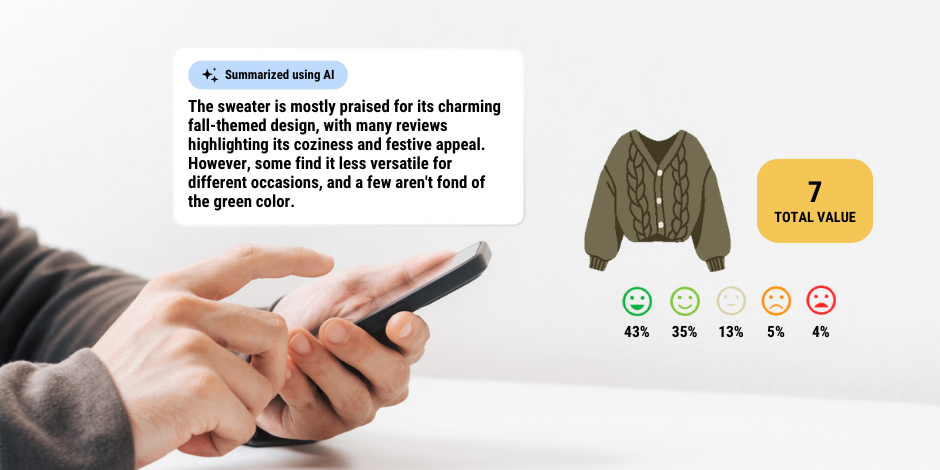
- Comments Summarization Per Item: Instead of manually combing through thousands of comments, retailers can now access a concise 2-3 sentence summary of customer sentiment for each item. This is a game-changer, especially when dealing with large product lines or seasonal assortments.
- Aspect-Based Sentiment Analysis: Want to know how customers feel about specific attributes like color, fit, or quality? InsightIQ breaks down comments into these key aspects, allowing retailers to make more targeted decisions on product improvements or marketing strategies.
- Automated Comment Translation: For global retailers, this feature automatically translates customer feedback, providing insights from all over the world, without the hassle of managing language barriers.
 The Time-Saving Potential of AI-Driven Comment Analysis
One of the most significant advantages of InsightIQ Sentiment is the time it saves. Traditionally, analyzing thousands of comments—often hundreds per product—could take days or even weeks. With InsightIQ, this process is reduced to minutes. Retail teams can quickly review summarized insights, enabling them to respond to emerging trends faster and make smarter decisions about product assortments, marketing campaigns, and pricing strategies.
Deepen Customer Understanding with Aspect-Based Sentiment Analysis
Understanding not just what customers think but why they think it is critical for refining products and targeting the right market segments. InsightIQ’s aspect-based sentiment analysis goes beyond basic feedback to identify key product attributes that drive customer satisfaction or dissatisfaction. Whether it’s the color, fit, or material, this feature helps retailers focus on the most important aspects of product performance and innovate accordingly.
For example, if comments reveal consistent praise for the fit of a jacket but dissatisfaction with its color options, retailers can use this insight to adjust the color offerings while retaining the popular fit—a much more targeted approach to product improvement and development.
Breaking Language Barriers with Automated Comment Translation
For brands with a global presence, the ability to quickly interpret feedback from different markets is critical. InsightIQ’s automated translation feature makes this possible by seamlessly converting customer comments into English. This ensures that retailers have a comprehensive understanding of their international audience, leading to more tailored global product strategies.
Generative AI Empowers Smarter, Faster Retail Decisions
InsightIQ Sentiment is a game-changing tool for retailers looking to improve their product assortments, marketing strategies, and overall customer satisfaction. By harnessing the power of generative AI, retailers can now analyze customer feedback more quickly and accurately than ever before, saving time while gaining deeper insights into customer sentiment. Don’t let the volume of customer feedback hold you back—start leveraging InsightIQ Sentiment today to make smarter, more profitable decisions for your business.
Explore InsightSUITE’s latest release and discover how generative AI can transform the way you analyze customer feedback and optimize your product strategies. Reach out to your First Insight expert today!
 retailerssentimentretail technologyvoice of the customerretail trendsVoCcustomer sentimentCustomer FeedbackInsightIQ SentimentWed, 09 Oct 2024 12:35:59 GMTinfo@firstinsight.com (First Insight)https://www.firstinsight.com/blog/saving-time-and-getting-closer-to-your-customers-with-the-all-new-insightiq-sentiment2024-10-09T12:35:59Z